Making AI Explain Its Decisions: Bengaluru Researchers Develop an Open-Source Tool for More Transparent AI
- 13 October 2026
- 2 min read
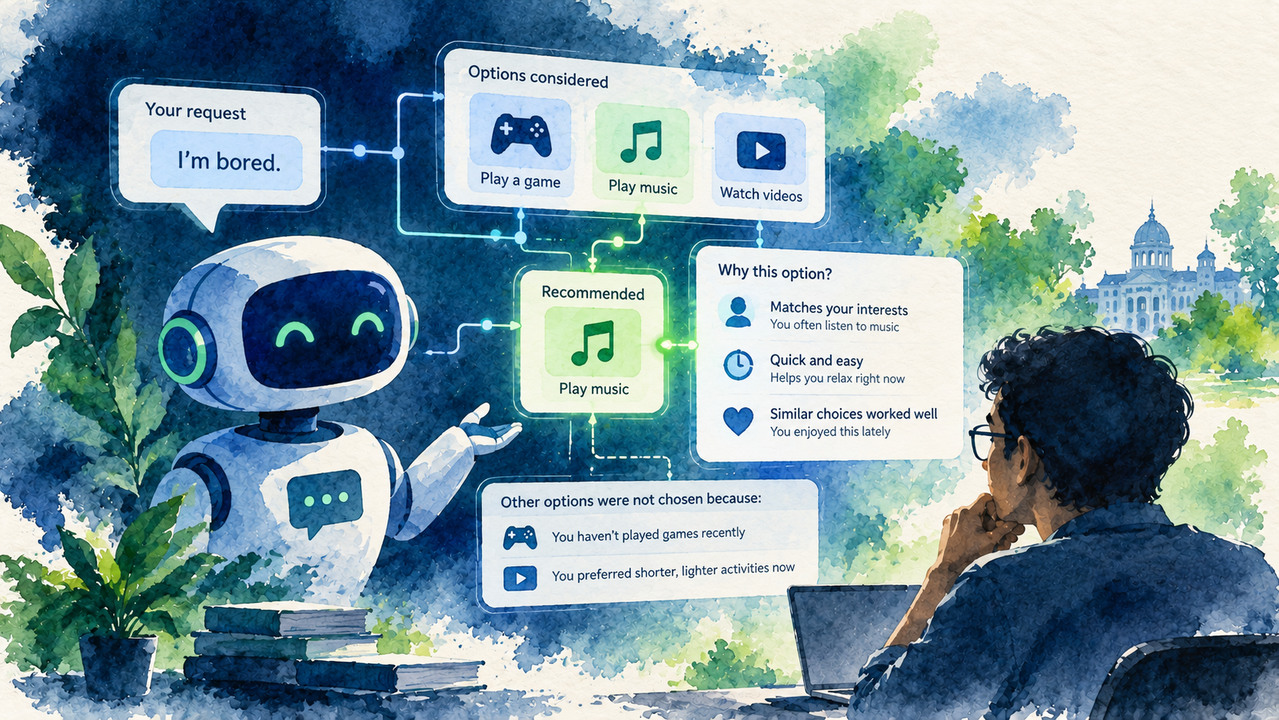
Researchers at Samsung R&D Institute India–Bangalore have developed GoAT, a framework that helps explain how AI systems involving multiple specialised agents arrive at a decision. Instead of showing only the final answer, it records the options considered, the information used and why one option was chosen. Its open-source implementation gives developers a tool to build more understandable AI applications.
AI assistants are becoming capable of handling complex tasks by coordinating several specialised AI agents. One agent might interpret a request, another retrieve relevant information, and another recommend an action. But when these agents work together, it can be difficult for users and developers to understand why the system reached a particular decision. Researchers at Samsung R&D Institute India–Bangalore have developed Graph of Agentic Thoughts (GoAT) to address this challenge. Imagine telling an AI assistant that you are bored. It might suggest playing a game, listening to music or watching short videos. A conventional system may provide a recommendation without explaining why it chose that option. GoAT creates a connected record of the decision-making process, including the different plans considered, the context and user preferences that influenced the choice, and the reasons alternative plans were rejected. This allows the system to generate explanations for everyday users while also giving developers a more detailed record to investigate errors and improve their applications. The researchers evaluated GoAT against four existing approaches using 2,000 multi-turn conversations from an internal personal-assistant dataset and 1,000 conversations from the public MultiWOZ 2.4 dataset. It outperformed the comparison methods across the reported automated evaluation metrics. In a separate human evaluation involving 50 conversations and seven independent researchers, GoAT received an average score of 4.71 out of 5 for its impact on user trust, 1.07 points higher than the strongest comparison method. These results suggest that explaining why an AI system selected one option over others may make its behaviour easier to understand and assess. The team has released langgraph-goat, an open-source Python implementation designed for LangGraph, a framework used to build AI systems that coordinate multiple agents. Developers can explore the code and adapt it to their own projects. The work is a step towards more explainable AI, although clearer explanations do not by themselves guarantee that an AI decision is correct, fair or safe.
More Stories

A Small Mirror with a Big Role in Satellite Communication

IISc and Samsung Join Hands to Advance Quantum Technology in India