
Scientists Break a Century-Old Limit to Detect Tiny Temperature Changes
- 1 September 2026
- 2 min read
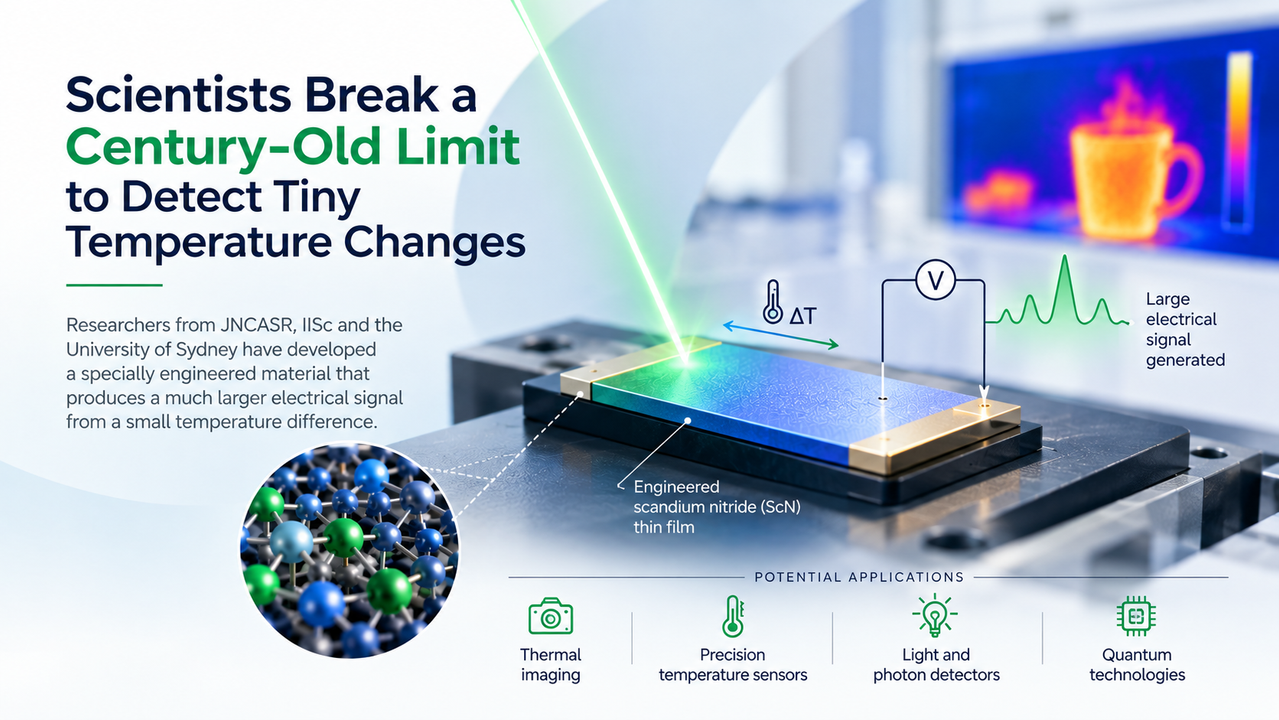
Researchers from JNCASR, IISc Bengaluru and the University of Sydney have developed a specially engineered material that produces an unusually large electrical signal when its temperature changes. The discovery could help create more sensitive devices for detecting heat and light, with potential applications in thermal imaging and emerging quantum technologies.
Turning tiny temperature changes into large electrical signals
Detecting very small changes in temperature is important in applications ranging from scientific instruments and thermal imaging to light detection. However, scientists have long considered the electrical response produced by a temperature difference in crystalline solid materials to have a practical upper limit. Researchers from the Jawaharlal Nehru Centre for Advanced Scientific Research (JNCASR), IISc Bengaluru and the University of Sydney have now demonstrated an unusually large thermoelectric response in a specially engineered form of scandium nitride (ScN), challenging this long-standing understanding.
The team introduced magnesium into scandium nitride to balance electrical charges within the material, creating what is known as a heavily doped, highly compensated semiconductor. This engineered arrangement produces an exceptionally large Seebeck effect—the generation of an electrical voltage when two parts of a material are at different temperatures. The researchers also built an early photon sensor using a thin film of the material. When one contact was illuminated with a laser, the resulting local temperature difference generated a measurable electrical signal. The findings were published in Science.
What does this mean in everyday terms?
Imagine trying to detect the warmth produced by a tiny light source. Normally, such a small temperature change may produce an electrical signal that is difficult to measure. This new material can turn that small difference in temperature into a much larger electrical signal, making it easier for a sensor to pick up. In simple terms, it acts like a highly sensitive heat detector that converts a tiny temperature change into an electrical response. With further development, this approach could help improve thermal cameras, precision temperature sensors and devices that detect extremely weak light. It is still an early-stage technology, so these applications will require further testing and development.
Research team
The team was led by Prof. Bivas Saha at JNCASR, with researchers from JNCASR, IISc Bengaluru and the University of Sydney.
Research publication: Science (2026). DOI: https://doi.org/10.1126/science.aef9458
Original news source: The Times of India.