
Smartphone-Based System Developed by JNCASR Scientists to Help Detect Alzheimer’s Disease
- 5 August 2026
- 2 min read
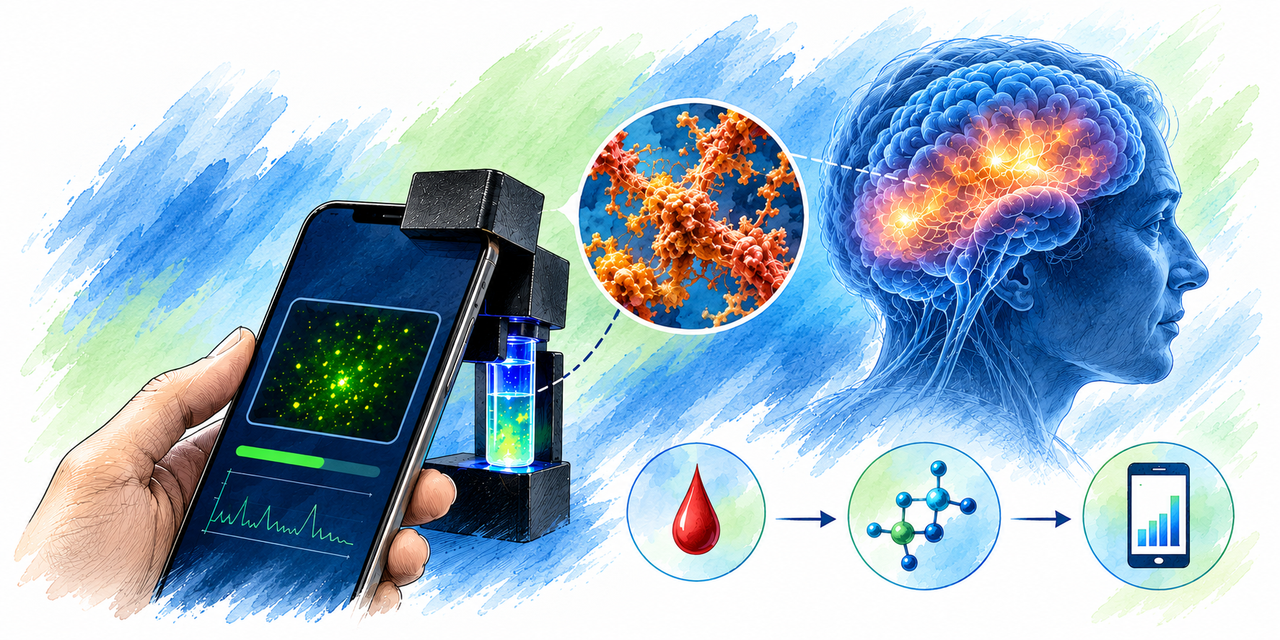
JNCASR researchers in Bengaluru have developed a smartphone-based system designed to detect a biological marker associated with Alzheimer’s disease. By combining a specially designed fluorescent molecule with smartphone-based analysis, the technology could help make testing more accessible and affordable in the future.
A smartphone-based approach to Alzheimer’s detection
Alzheimer’s disease is a progressive brain disorder that affects memory, thinking and everyday functioning. Detecting the disease and assessing its progression remain important challenges, creating a need for diagnostic technologies that are sensitive, accessible and practical to use.
Researchers at the Jawaharlal Nehru Centre for Advanced Scientific Research (JNCASR), Bengaluru, have developed a smartphone-enabled diagnostic platform called ADxFluor. The system uses a specially designed fluorescent molecule, TZ-48, to detect amyloid-beta (Aβ), a protein associated with Alzheimer’s disease. The research was published in ACS Chemical Neuroscience in 2026.
How does it work?
The molecule TZ-48 responds to amyloid-beta by changing its fluorescence characteristics. The researchers use these changes to measure the biomarker in biological samples, including blood serum. The ADxFluor platform uses a smartphone to capture and analyse the fluorescence response, offering a potential route to more portable and accessible testing.
In simple terms, imagine using a special chemical marker that lights up differently when it encounters a substance associated with a disease. A smartphone can capture that signal and help measure it. This could eventually make certain types of testing easier to carry out without relying entirely on complex laboratory equipment. However, the research is not evidence that anyone can currently diagnose Alzheimer’s reliably using an ordinary smartphone alone. Further clinical validation and development are needed before routine medical use.
The work was carried out by Krithi K. Bhagavath, Madhu Ramesh, Yogendra Kumar, Sabyasachi Mandal, Hiriyakkanavar Ila and Thimmaiah Govindaraju at JNCASR.
Research paper: Fluorescence Lifetime and Smartphone-Enabled Detection of Amyloid-β for Diagnosis and Staging in Alzheimer’s Disease.
DOI: https://doi.org/10.1021/acschemneuro.6c00230
Original news source: The Hindu.
More Stories

DISHA: Developing an Integrated Surveillance Framework for Non-Communicable Diseases

Financing India’s Power, Transport, and Industry Transitions: Gaps, Instruments, and the Way Forward